
 +1 915 229 3004 (U.S.) |
  +44 7452 242832 (U.K.)
+1 915 229 3004 (U.S.) | +44 7452 242832 (U.K.)

Research Layer announces the publication of its half-cooked research report-Global Autoimmune Disease Diagnosis Market, 2022-2030
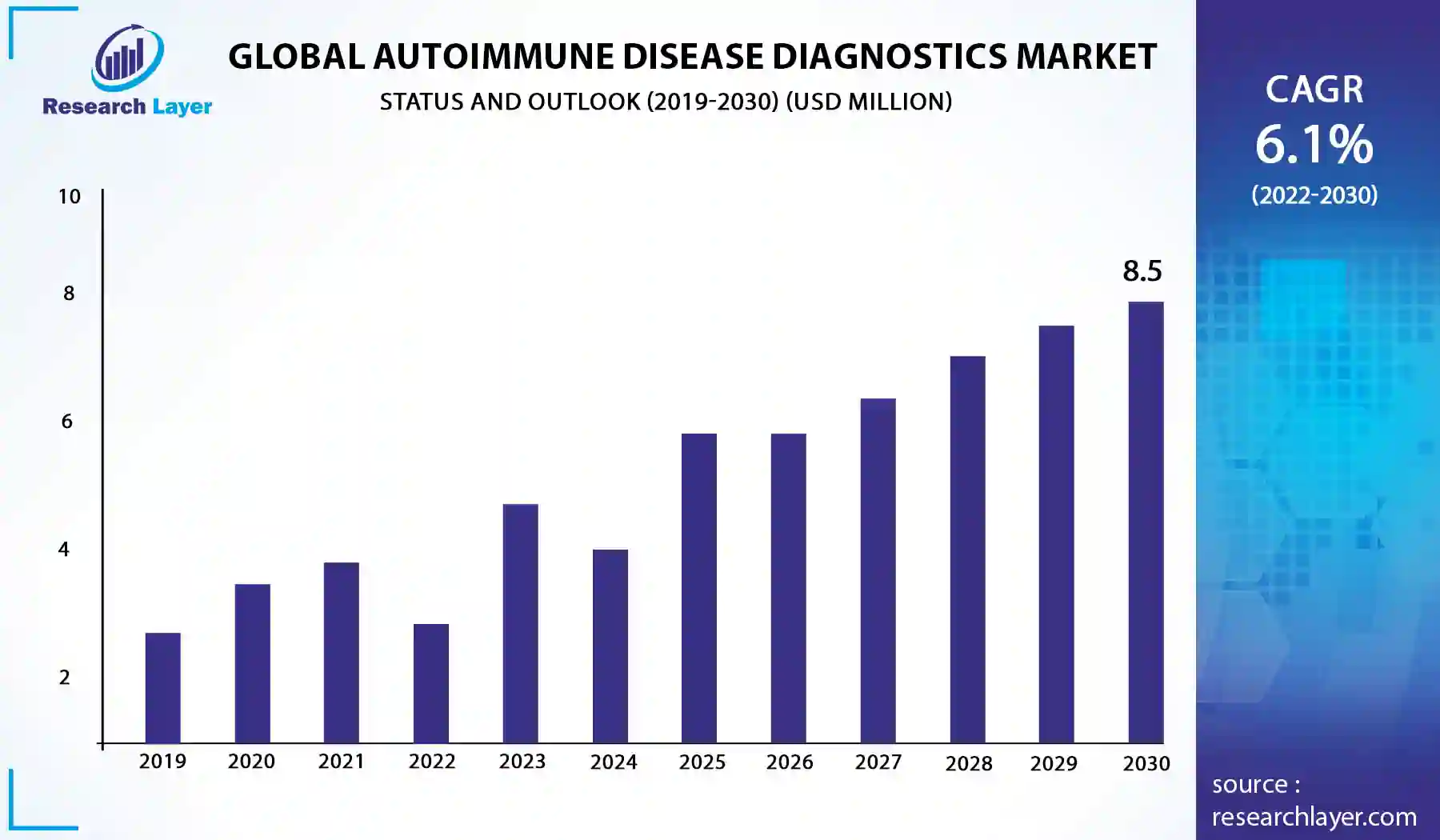
According to Research Layer, the global Autoimmune Disease Diagnosis Market has been segmented into component, communication infrastructure, device usage, end use, and region/country. The global Autoimmune Disease Diagnosis Market is expected to surpass USD 8.5 Billion by 2030 with a CAGR rate of 6.1% during the projected period.
An aberrant immune response in the body causes the development of antibodies that then target the body's own cells and tissues, destroying them in the process. This is what we mean when we talk about autoimmune illnesses. Systemic lupus erythematosus and rheumatoid arthritis are only two of the almost 80 autoimmune disorders that affect people all over the world. Up to 50 million Americans, with 75% being females, are living with an autoimmune disease, according to the American Autoimmune Related Diseases Association (AARDA). Autoantibody testing, antinuclear antibody testing, a full blood count, C-reactive protein testing, and erythrocyte sedimentation rate testing are all used to identify autoimmune disorders.
The global Autoimmune Disease Diagnosis Market has been segmented based on product, test type, target disease, end use, and region/country.
On the basis of product, the global market is segmented into consumables & assay kits, instruments, and services.
On the basis of Type, the global market is segmented into antinuclear antibody tests, autoantibody tests, Complete Blood Count (CBC), C-reactive Protein (CRP), urinalysis, and others tests.
On the basis of target disease, the global market is segmented into systemic autoimmune disease and localized autoimmune disease.
On the basis of end use, the global market is segmented into clinical laboratories, hospitals, research laboratories & institutes and others.
The global Autoimmune Disease Diagnosis Market has been analyzed for five regions—North America, Europe, Asia-Pacific, the Middle East & Africa, and South America.
One of the key reasons expected to drive market expansion in the near future is the rising prevalence of autoimmune illnesses among patients. Some of the most prevalent conditions requiring autoimmune diagnosis and treatment include type 1 diabetes, rheumatoid arthritis, psoriatic arthritis, and inflammatory bowel disease.
Insulin-producing cells in the pancreas are targeted and destroyed by the immune system, leading to type 1 diabetes, a lifelong condition. When this happens, blood sugar levels rise, which can damage several body systems if not addressed. The International Diabetes Federation, for example, estimates that by 2021, more than 1.2 million children and adolescents younger than 19 will have been diagnosed with type 1 diabetes, and that figure will continue to rise. In addition, the American Diabetes Association estimates that in 2019 more than 1.9 million Americans have Type 1 diabetes. As the incidence of these diseases rises, they bring with them serious complications and additional health risks, as well as a high death toll. Therefore, the increasing number of patients is expected to drive rapid growth in the diagnostics market for autoimmune diseases.
The increased use of autoimmunity diagnostic tools in hospitals performing difficult interventional operations. Hospitals provide high-tech labs, excellent physiotherapy sessions, enhanced patient aid and counselling, and other services that guarantee growth in the market and stimulate demand. Market growth will also be spurred by the increasing prevalence of a number of chronic illnesses and neurological disorders that can lead to autoimmunity. Market expansion in the field of autoimmune disease diagnosis can be attributed, in part, to the rising availability of highly trained medical and healthcare experts and cutting-edge facilities.
However, several diagnostic tests may be required, and the market expansion may be hampered by the large capital expenditure needed to set up diagnosis centres and the lengthy wait for test results. Business growth at diagnostics facilities specialising in autoimmune diseases may be hampered by the presence of strict government rules and diagnostic problems. Autoimmune disease can be diagnosed and its severity assessed using a battery of blood tests including C-reactive protein (CRP), erythrocyte sedimentation rate (ESR), enzyme-linked immunosorbent assay (ELISA), rheumatoid factor (RF), and others.
The market share in North America is significantly larger than in any other region. Increases in both awareness and spending on healthcare are fueling the expansion of the market that has been researched. This, in turn, is helping to alleviate the suffering of those living with chronic conditions. The United States has the greatest frequency of autoimmune disorders (AD), and between 15 and 30 million people in the United States currently have an autoimmune disorder (AD).
The key players in the global Autoimmune Disease Diagnosis Market are Abbott Laboratories, BioMérieux SA, Bio-Rad Laboratories, PerkinElmer, F Hoffmann-La Roche Ltd, Siemens Healthcare GmbH, Thermo Fisher Scientific, Inova Diagnostics Inc., Myriad Genetics Inc, and Trinity Biotech Plc.