
 +1 915 229 3004 (U.S.) |
  +44 7452 242832 (U.K.)
+1 915 229 3004 (U.S.) | +44 7452 242832 (U.K.)

Research Layer announces the publication of its half-cooked research report—Global Automobile Metal Castings Market, 2022-2030
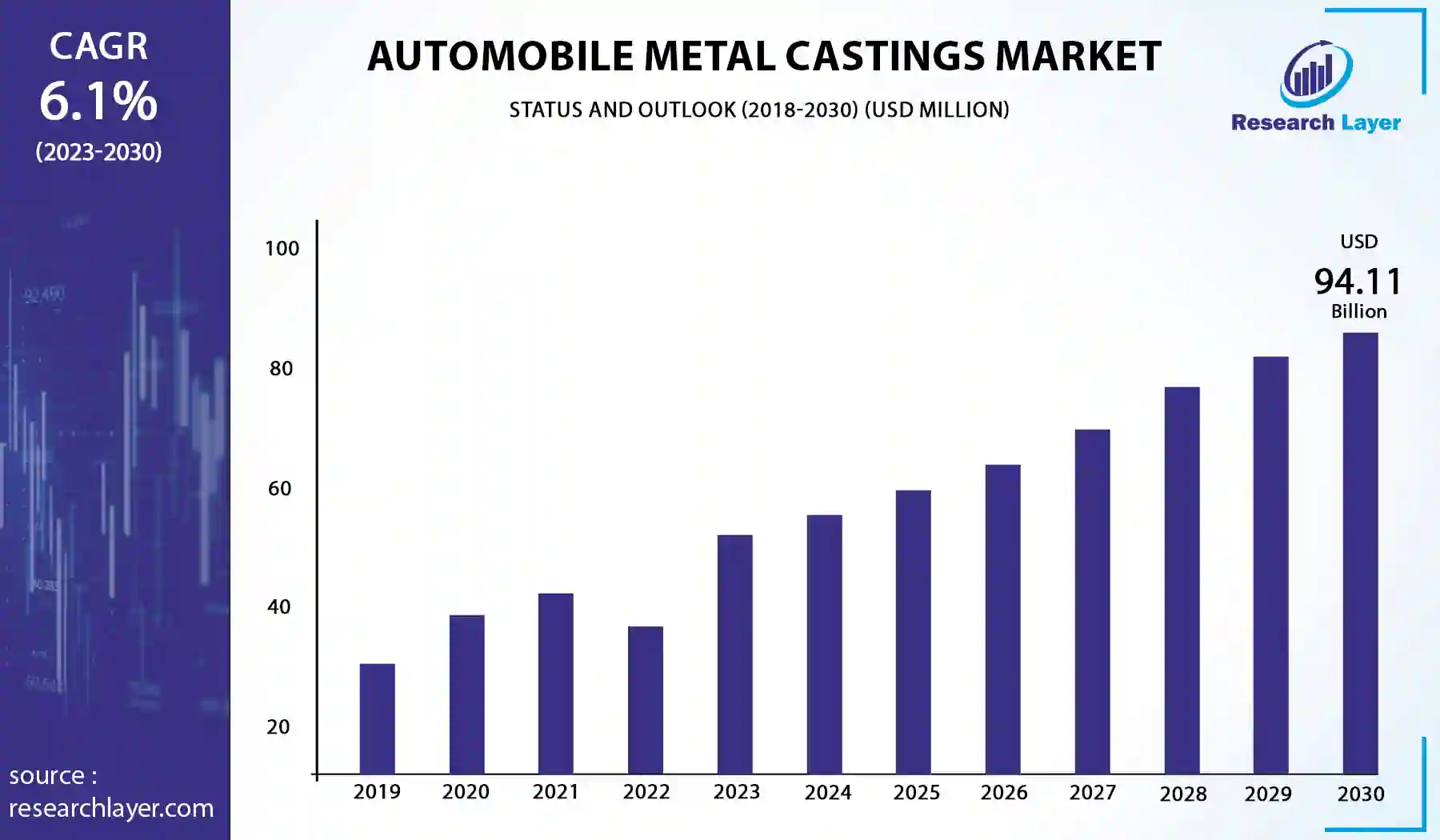
According to Research Layer, the global Automobile Metal Castings Market has been segmented into component, communication infrastructure, device usage, end use, and region/country. The the global Automobile Metal Castings Market is expected to surpass USD 94.11 Billion by 2030 with a CAGR rate of 6.1% during the projected period.
The market is anticipated to see revenue growth due to the automotive industry's quick expansion and rising demand for HCV, BEV, HEV, and PHEV vehicles. For example, Volvo declared on February 21, 2022, that it will manufacture Electric Vehicles (EV) utilising a variety of sophisticated castings, including single, cut, mega, and others. The business wants to make the process of making automobiles simpler by replacing many little pieces with huge metal castings. This Swedish automaker has disclosed plans to invest around USD 1.1 billion in the Torslanda production facility for mega casting, which will include an aluminium body and other substantial internal body part improvements.
The global Automobile Metal Castings Market has been segmented based on material type, application, and region/country.
Based on material type, the global automobile metal castings market is segmented into steel casting, aluminum casting, zinc casting, and other material types.
Based on application, the global automobile metal castings market is segmented into body, powertrain, chassis, and other applications. Interior system and wheels are the other applications in the automobile metal castings market.
The global Automobile Metal Castings Market has been analyzed for five regions—North America, Europe, Asia-Pacific, the Middle East & Africa, and South America.
Market revenue growth is anticipated to be fueled by technological improvements, global disruptions, shifting consumer tastes, and a quick rise in disposable income. The need for metal casting is anticipated to continue increasing as long as automobiles are manufactured, designed, serviced, sold, and financed. As a result of spending more time alone, which has prompted people to choose other housing options, Covid-19 has altered how people are seen and raised interest in innovative activities. The use of metal casting components for producing various necessary parts in both the construction and automotive sectors has expanded along with their respective industries' growth. For instance, on November 30, 2021, Foundry Lab, a digital casting startup based in New Zealand, announced an investment of about USD 8 million for the development of microwave casting technology that can produce different metal castings the same day, which is expected to boost the metal casting industry's revenue growth.
Many automakers are working to lighten their vehicles in an effort to increase fuel efficiency and lower emissions. In order to lower total vehicle weight and increase vehicle economy, lightweight materials like aluminium are gradually replacing conventional metals like cast iron. Population growth, growing consumer spending, and technology advancements will all have a favourable impact on the world's car output.
Automotive manufacturers will be encouraged to reduce vehicle weights by strict government rules enforced by regulatory organisations. The European Union established a number of laws and rules to limit the CO2 emissions from cars. The amount of emissions has been drastically lowered during the last few years as a result of these laws. According to the European Environmental Agency, between 2007 and 2017, passenger car CO2 emissions decreased on average by 40.2 Gco2/km. Regulation (EU) 2019/631, which outlines the rules for CO2 emission performance criteria for new passenger cars and new light commercial vehicles for the years following 2020, was recently enacted by the European Parliament and the Council.
As one of the world's major centres for the production of automobiles, North America now holds a monopoly on the market for automotive metal castings. The North American automotive metal castings market is largely driven by the large number of cars that are produced there annually, which has eventually raised demand for automotive metal castings. The cost of producing a vehicle is rising, which is pushing the automotive industry to outsource the production of metal castings for the body, chassis, and powertrain, including the engine. The North American vehicle metal castings industry is being driven by the presence of major automakers and an increase in the number of auto component producers.
The key players in the global Automobile Metal Castings Market are Nemak (ALFA, S.A.B. de C.), Ryobi Limited, GF Casting Solutions, Rheinmetall Automotive AG (Rheinmetall AG), Mino International, GIBBS (Koch Enterprises Inc.) and Meridian Lightweight Technologies.