
 +1 915 229 3004 (U.S.) |
  +44 7452 242832 (U.K.)
+1 915 229 3004 (U.S.) | +44 7452 242832 (U.K.)

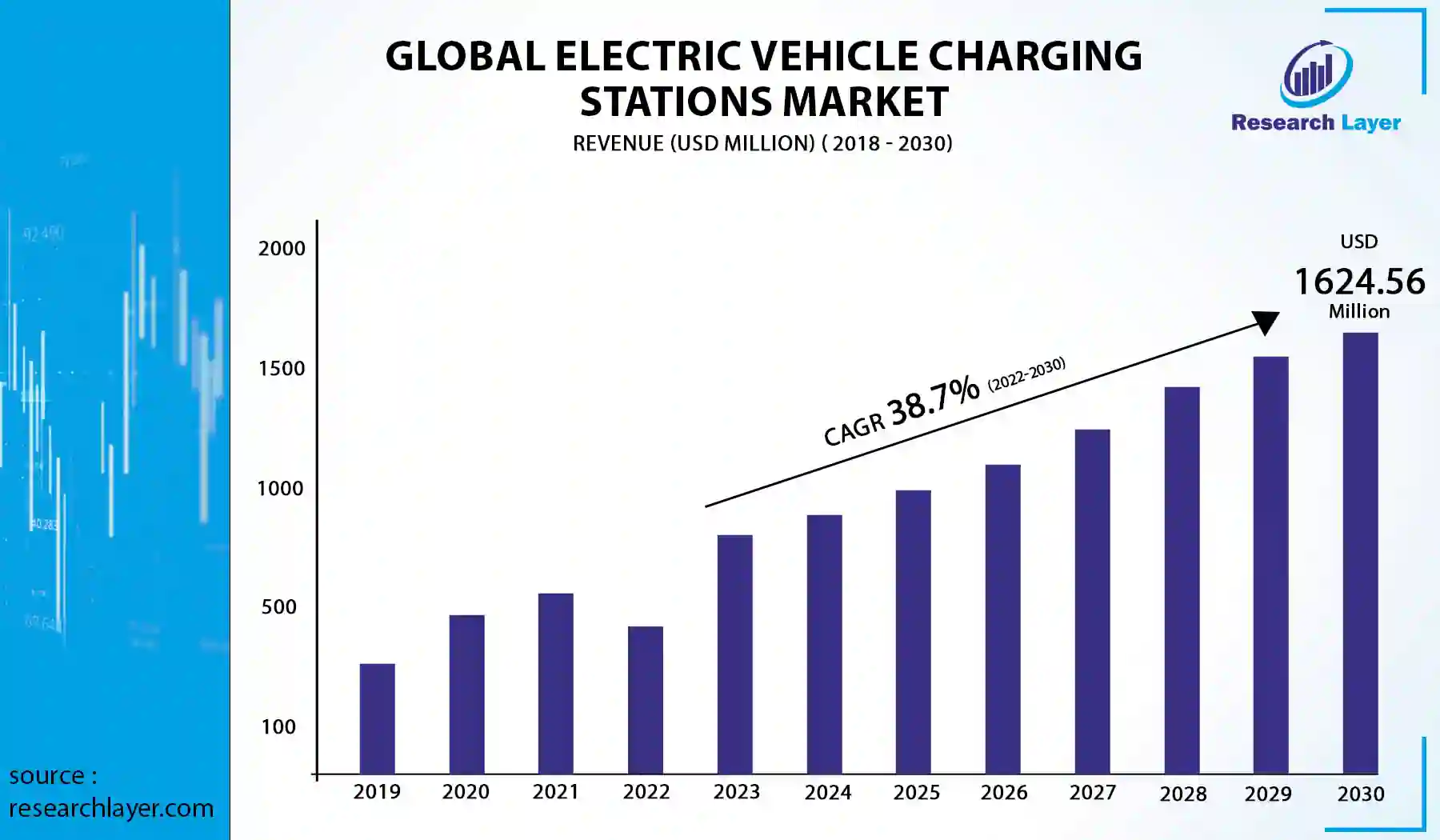
Research Layer announces the publication of its half-cooked research report—Global Electric Vehicle Charging Stations, 2022-2030
According to Research Layer, the global Electric Vehicle Charging Stations has been segmented into charging station, power output, supplier type, end use, and region/country. The Global Electric Vehicle Charging Stations Market is expected to surpass USD 1624.56 Million by 2030 with a CAGR rate of 38.7% during the projected period.
The market for electric vehicle charging stations will rise as more people choose to drive cars with no emissions. In addition to the development of ultra-fast charging technology, new opportunities will arise as a result of technological advancements such as portable charging stations, bi-directional charging, smart charging with load management, usage-based analytics, and automated payment. Faster installation of EV charging stations has been facilitated by the forthcoming standardisation of charging ports and government rules by the world's leading economies (estimated around 2025; Tesla already offering ports for CCS; CHAdeMO already having GB/T ports as of December 2021).
The Global Electric Vehicle Charging Stations has been segmented based on charging station, power output, supplier type, end use, and region/country.
Based on the component insights, the Global Electric Vehicle Charging Stations has been segmented into AC Charging, DC Charging, and Wireless Charging.
Based on the communication infrastructure outlook, the market has been segmented into <11KW, 11KW-50KW, and >50KW.
Based on the device usage outlook, the Global Electric Vehicle Charging Stations has been segmented into OE Charging Station and Private Charging Station.
Based on the end use insights, the market has been segmented into Private Type and Public Type.
The Global Electric Vehicle Charging Stations has been analyzed for five regions—North America, Europe, Asia-Pacific, the Middle East & Africa, and South America.
Up to 80% of the cost of installing charging infrastructure is being subsidised by many governments. Many national governments are working with oil and gas firms to design and build charging stations, which has facilitated the growth of the EV industry. During the projection period, the Electric Vehicle Charge Stations Market will expand thanks to government plans to establish charging stations every 100 kilometres along the national highway.
Intelligent mobility and electrification are changing the face of mobility by hastening the transition from gas-powered to electric vehicles. Multiple automakers, utility providers, and property management firms are currently building fast EV charging stations. These are some developments in the market for EV charging stations that are likely to have a major impact on the growth of the charging infrastructure sector.
Subsidies, rebates, tax exemptions, and quotas are all things that the government is offering to the auto industry. Purchase decisions for electric vehicles are significantly influenced by government subsidies. Because of these causes, EV sales and manufacturing have expanded globally. In order to keep up with the increasing number of electric vehicles, reliable charging infrastructure and stable power grids are essential. Therefore, these elements are responsible for the market's expected expansion. In addition, customers have been encouraged to embrace EVs by tough government vehicle emission rules, which will contribute to the expansion of the electric charging station industry in the coming years.
Moreover, the rising acceptance of Mobility as a Service (MaaS) is anticipated to fuel market expansion. Additionally, the subscription-based charging models are receiving a great deal of attention, which is fueling the expansion of the EV charging station. Many utilities, like Vattenfall AB, Duke Energy Corporation, and New York Power Authority have partnered with OEMs to offer subscription-based services to their customers, as outlined in the model. However, the various costs associated with the EV charging infrastructure, such as maintenance cost, installation cost, and operational cost, are impacting negatively on the market growth. For example, in April 2019, Duke Energy Corp. signed a partnership agreement with ChargePoint Inc. to offer subscription-based services to its EV drivers in the US state of North Carolina.
Asia-Pacific region is expected to be the largest market for electric vehicle charging stations
Increasing infrastructure investment, supportive government initiatives, and heightened public interest in protecting the environment have positioned the Asia-Pacific region to become the world's largest market for EV charging stations. While the United States spends relatively little on electric car infrastructure, countries like China and Japan are making significant investments and expanding their use of electric vehicles. In addition, the government in this area is allocating substantial resources to electric vehicle-related research and development and providing incentives to support charging stations. Both the number of electric vehicles and the number of charging stations for them have increased in China. The number of rapid charging facilities for electric vehicles is highest in Japan. By boosting national production of electric vehicles and investing in the extension of charging infrastructure, countries like South Korea and India are taking massive measures to cut greenhouse gas emissions.
The key players in the global Electric Vehicle Charging Stations are ABB Ltd., AeroVironment, Inc., ChargePoint Inc., EV-Box B.V., Fastned B.V., Pod Point Ltd., Robert Bosch GmbH, Schneider Electric SE, Siemens AG and Tesla Motors Inc. are prominent players of the market.