
 +1 915 229 3004 (U.S.) |
  +44 7452 242832 (U.K.)
+1 915 229 3004 (U.S.) | +44 7452 242832 (U.K.)

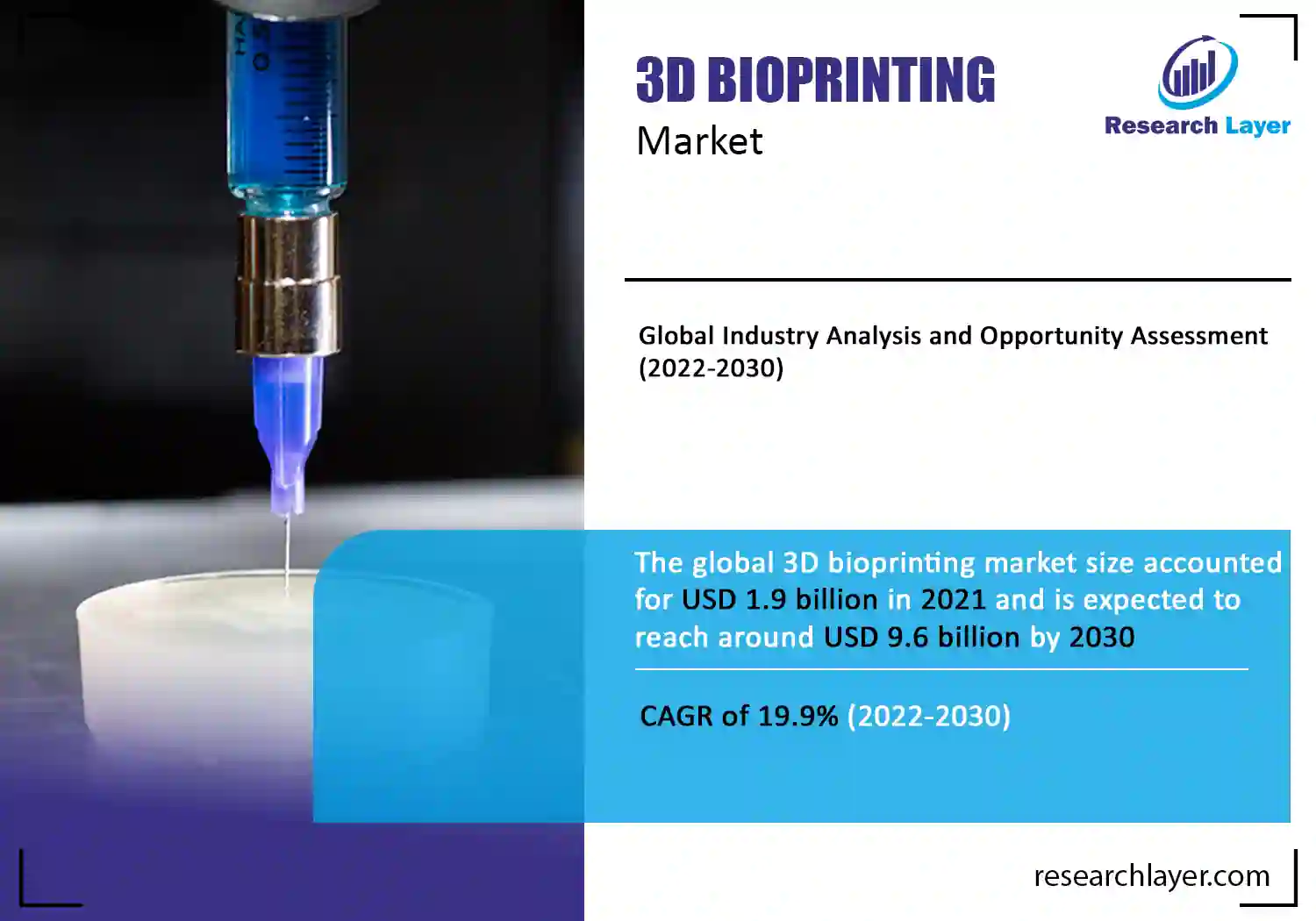
According to Research Layer, The global 3D bioprinting market size accounted for USD 1.9 billion in 2021 and is expected to reach around USD 9.6 billion by 2030 and is poised to grow at a compound annual growth rate (CAGR) of 19.9% during the forecast period 2022 to 2030.
A respiratory epithelium model was recently produced by the 3D bioprinting business CLECELL using its own U-FAB printer and other bioprinting technologies. The majority of the respiratory tract is lined with a type of tissue called respiratory epithelium. This epithelium serves as a defence against pathogens and foreign objects. However, with the aid of the mucociliary elevator, it also guards against infection and tissue damage. Consequently, it is anticipated that the market for 3D bioprinting will expand as a result of rising incidences of demand for this respiratory epithelium model. The market is anticipated to experience greater growth during the forecast period as a result of such innovations.
To speed up COVID-19 research, many biotherapeutic companies are utilising 3D bioprinting technology. For instance, Viscient Biosciences created lung tissue using 3D bioprinting technology to support viral infectivity research and aid in the search for an effective treatment for SARS-CoV-2, the novel coronavirus that causes COVID-19. A fully injection-molded nasopharyngeal swab has been developed by the Harvard University Wyss Institute in conjunction with medical professionals, business partners, and other research organizations.
Rapid COVID-19 virus dissemination has increased interest in 3D bioprinting. This has led to numerous pharmaceutical and biopharmaceutical firms doing their part to back the healthcare industry and its practitioners and investigators. In the United States, Stratasys, one of the leading 3D printer manufacturers, has employed a 3D bioprinter to make protective masks. Up to March of 2020, a total of one hundred thousand face shields were dispersed around the United States.
Download Free Report Sample to learn more about this report.
This new COVID-19 pandemic has swept the globe and is overwhelming medical facilities. Therefore, several 3D Bioprinting communities are reacting to the global crises by providing their unique skills to ease the burden on the supply chain and governments. Reason being, an increase in coronavirus manifestations. As the number of reported cases of COVID-19 rises everyday, there has been a shortage of information for the public and healthcare providers. One of the major issues is the scarcity of COVID-19 diagnostic kits. As a result, multiple 3D bioprinting enterprises develop 3D printers and accompanying software on a vast scale. Massachusetts-based Formlabs, for instance, reportedly manufactures one hundred thousand nasal swabs every day for COVID-19 analysis. The need for 3D bioprinters is rising as a result of the rising COVID-19 cases, and the 3D bioprinting market as a whole is expected to experience exponential growth.
The coronavirus pandemic has also sped up the development of vaccine and drug testing, since researchers are utilising new technology for patient safety testing following the conclusion of preclinical trials. There is a shortage of respirators and ventilators in the medical community as a result of the rising number of COVID-19 cases. Due to a lack of these equipment, 3D bioprinting technology is assisting in the production of respirators and ventilators.
3D Bioprinting Market Driver
3D bioprinting is being used more and more in the cosmetics and pharmaceutical industries
Many pharmaceutical companies are quickly utilising 3D bioprinting products and technology in the search for and development of new medicines. The drug industry can test medications more affordably and safely thanks to 3D bioprinting than it could before compared to the traditional drug test procedure.
The 3D bioprinting technique enables pharmaceutical companies to test a medication in a matter of hours, cutting the three to six years it typically takes to develop a new drug. Using 3D bioprinted tissues, R&D teams can test new medications early on and during preclinical studies. Benefits of 3D bioprinting include fewer animal tests, higher productivity, and quicker medication development.
People's knowledge of 3D printing has expanded as its use has increased, especially in the cosmetics industry. Additionally, since March 2013, the European Commission had outlawed animal testing for cosmetics. In response, a number of businesses in the healthcare and cosmetics industries have used 3D bioprinting to develop cutting-edge 3D tissue models and methods for drug screening.
3D Bioprinting Market Opportunity
The need for organ transplants is growing
3D printing is playing an increasingly important role in the medical field because it offers the potential to manufacture complex solid organs like kidneys, the heart, and lungs for transplant. 3D-printed parts are less likely to pose risks than the conventional replacement of failed or injured organs, which carries the risk of the human host rejecting them, because they use blood-derived cells. 3D bioprinting holds great promise for the future of medicine because it can be used to create new organs during organ transplants and repair broken bones.
Additionally, it enables the printing of prosthetic limbs that can be used to replace individuals' missing legs. Furthermore, 3D bioprinting enables faster growth of organs and tissues than the traditional method, which requires a donor and is equally time-consuming. The waitlist for transplants grows longer every day as a result of the huge discrepancy between the demand for organs and the number of donations.
To solve this problem, scientists are developing synthetic organs. But the tiny organs that researchers have currently created are not quite suitable for implantation into a human body. These unmet business needs have pushed the development of 3D-printed transplanted parts.
3D Bioprinting Market Restraint
Process management and knowledge of 3D printers
The accuracy of the additive manufacturing process varies between machines as a result of uncontrollable processing parameters and various materials. A few monitoring methods are available to help producers correct these modifications and meet their particular requirements. The lack of systems integration knowledge has made it difficult to develop complex and accurate mathematical models using additive manufacturing. These limitations on preproduction, planning, and control systems frequently result in expensive errors and unsuccessful manufacturing.
To be practical on a commercial level, 3D bioprinting requires a faster manufacturing and scale-up process. Lack of readily available biomaterials for the process is one of the biggest issues facing the 3D bioprinting industry. The process of the biomaterial involves both the removal of created goods and the operational procedures for the disposal of waste. The lengthened manufacturing processes and increased likelihood of procedure variation caused by these control system variables are both serious issues for a number of processes and machines.
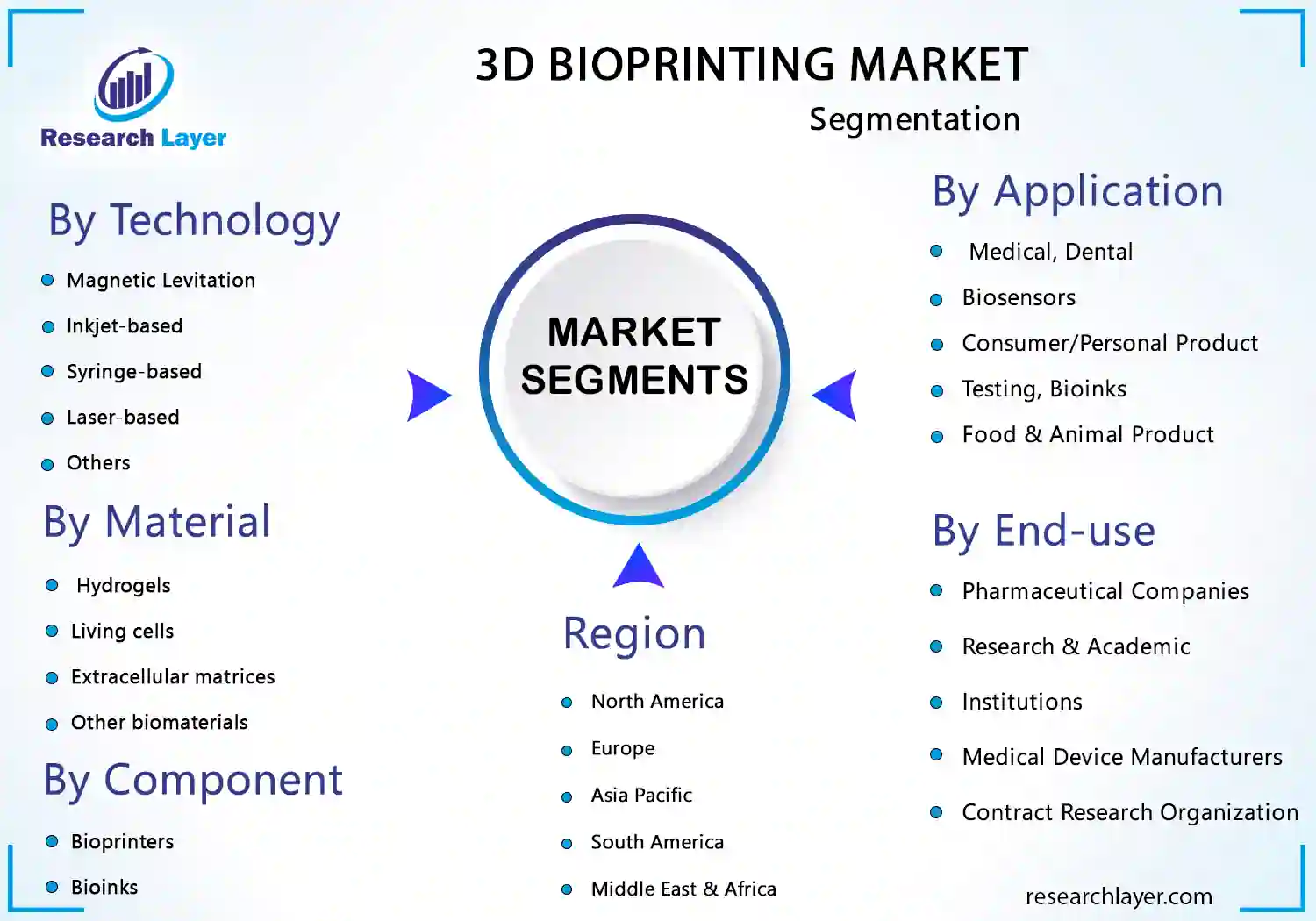
The global 3D Bioprinting Market has been segmented based on technology, application, material, component, end-use, and region/country.
The inkjet-based category, which had the largest revenue share at 36.0% in 2021, made it possible to print complex living organs or tissues on culture substrates with the use of biomaterials employed as bio-inks. This market is growing because inkjet printing is becoming increasingly commonplace in the healthcare sector. This research focuses on inkjet printing as a bio-applicable technology with specific applications in tissue engineering and medication delivery systems. This industry is anticipated to grow substantially during the forecast period as a result of rising demand and improved dependability.
The medical applications sub segment of the market held a 34.4% share of the market in 2021. The average annual rate of growth (CAGR) projected for the period in question is 15.6%. Due to the growing usage of pharmaceutical tablets to treat a number of chronic illnesses, the market for 3D bioprinting is expanding. Growth in the pharmaceutical industry is fueling this sector, as is the effective application of bio-drugs in this field. Increases in both demand for pharmaceuticals and the number of companies offering them reflect the booming nature of the industry. Pills and capsules are often used by millions of people around the world for various therapeutic reasons. Consequently, this market segment is anticipated to grow profitably throughout the forecast period.
Download Free Report Sample to learn more about this report.
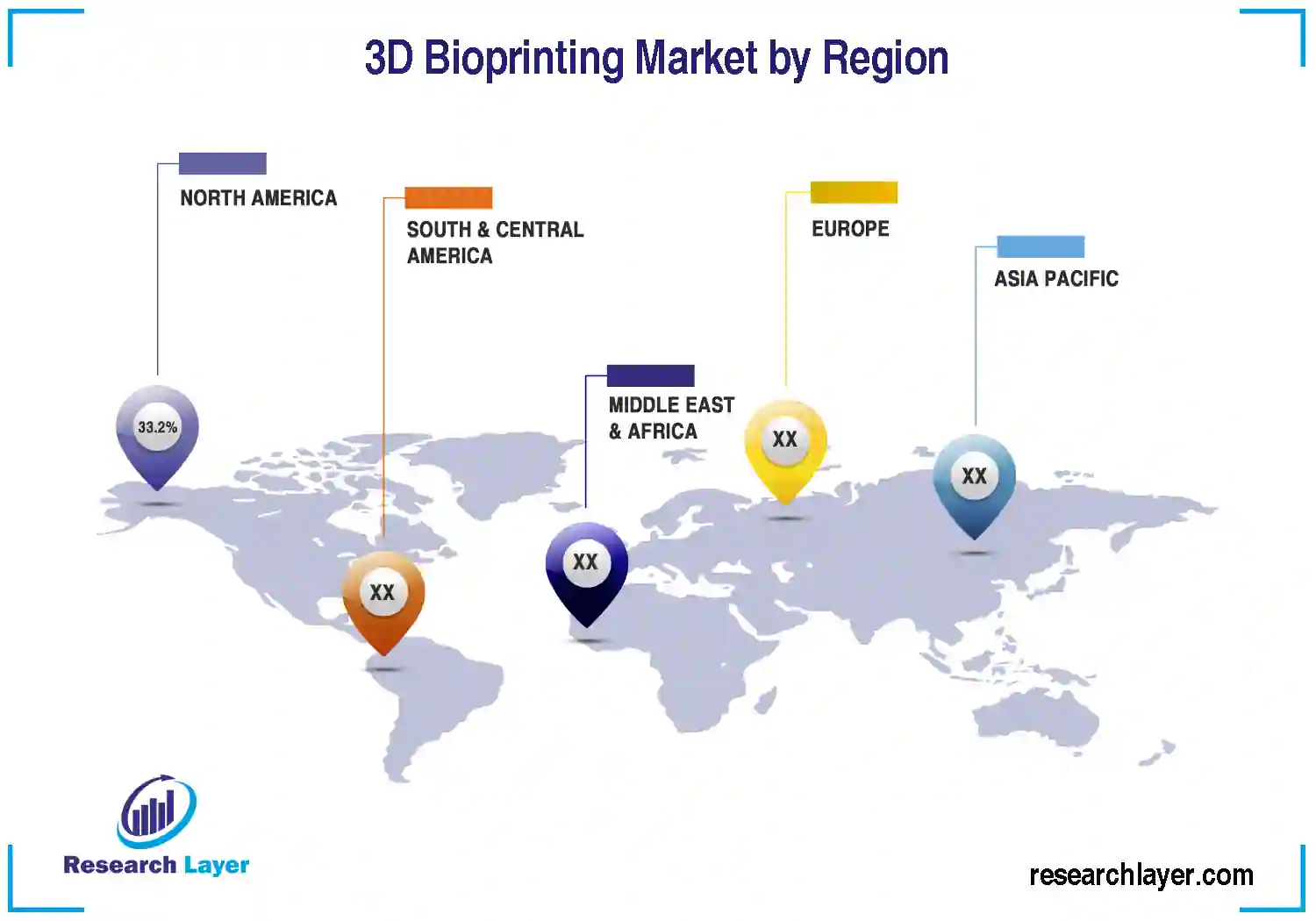
The global 3D Bioprinting Market has been analyzed for five regions—North America, Europe, Asia-Pacific, the Middle East & Africa, and South America.
The geographic analysis of the global 3D Bioprinting Market has been conducted for North America, Europe, Asia-Pacific, the Middle East & Africa, and South America.
In terms of revenue, Asia Pacific's share of the 3D bioprinting business was 24.6% in 2021, and this share is only predicted to grow over the course of the projection period. Japan and China accounted for the greatest revenue share in the area because of the increasing number of COVID-19 cases and the increasing R&D spending by the government. The Worldometer Report 2021 estimates that as of January 13, 2021, 87,706 COVID-19 instances were active in China. The increased death rate due to COVID-19 and the shortage of organ donors are also expected to boost the 3D bioprinting industry in this sector.
A total of 33.2% of the global market's revenue was generated in North America in 2021, and this region is projected to maintain its dominance throughout the forecast horizon. As healthcare organisations increasingly incorporate IT into patient care, the market is expected to expand during the forecasted time frame. As of January 13th, 2021, the Worldometer Report 2021 estimated that there were 23,369,732 active cases of COVID-19 in the United States alone. There are now more than fifty vaccines in various stages of testing. The government is increasing funding for R&D to create a vaccine for this disease. Demand for 3D bioprinting is on the rise as its potential applications in fields like drug research and organ transplantation become more widely known.
Download Free Report Sample to learn more about this report.
· BICO Company AB (USA) debuted The BIO CELLX in March 2022. This ground-breaking technology automates 3D cell cultivation processes by using prevalidated techniques.
· In June 2021, 3d Printers, Inc. (US) & CollPlant Biomaterials Limited inked a co-development agreement for such a 3D-bioprinted regenerative tissue substrate to be employed in reconstructive surgery procedures in conjunction with an implant (Israel).
· 2019 saw the launch of the CELLINK Epidermis Kit with CELLINK LIVER Kits. These kits provide information on the phenotypic characteristics of their tissue analogues, which helps researchers create reliable tissue designs for pharmacological and cosmetics research.
· Allevi's Epidermis Bioink Kit, which can grow skin patches, was released in 2019.
· In 2019, Organovo collaborated with Ton Rabelink from the Murdoch Children's Research Facility in Australia and Leiden University in the Netherlands. They want to expand and advance the usage of 3D-bioprinted cell lines for the treatment of advanced renal disease.
· In 2019, Digilab collaborated with Orgenesis, Inc., a US business. They aimed to develop functional cell manufacturing methods and procedures to automate the synthesis of three-dimensional living cell membranes and tissue.
· EnvisionTEC and Covestro announced their collaboration on material printer choices in September 2021 with the goal of lowering entry barriers for organisations desiring to adopt 3D printing for producing moulds for small batches or components with specific properties more quickly and profitably.
The key players in the global 3D Bioprinting Industry are, Envisiontec Inc, Organovo Holdings Inc, Inventia Life Science PTY LTD, Poietis, Vivax Bio, LLC, Allevi, Cyfuse Biomedical K.K., 3D Bioprinting Solutions, Cellink Global, Regemat 3D S.L., Bico group ab, Collplant biotechnologies ltd, Regenhu, Aspect biosystems ltd, Advanced solutions life sciences, llc, Rokit healthcare Inc, Pandorum technologies pvt. ltd, Foldink life science technologies, Revotek co.Ltd and Precise bio.
This study estimates revenue growth at global, regional, and country levels and offers an overview of the latest developments in each of the sub-sectors from 2022 to 2030. For this analysis, Research Layer segmented the global 3D Bioprinting Market has been segmented based on component, technology, software, application, vertical, and region/country.
· Potential Investors
· Regulatory & Government Bodies
· Research & Consulting Firms
· Upstream & Downstream Vendors
· End Users
· Others
Report Scope
The global 3D bioprinting market size was estimated at USD 1.9 billion in 2021 to 9.6 US Dollars by 2030.
The global 3D bioprinting market is expected to grow at a compound annual growth rate of 19.9% from 2022 to 2030
North America dominated the 3D bioprinting market
Some key players operating in the 3D bioprinting market include Envisiontec Inc, Organovo Holdings Inc, Inventia Life Science PTY LTD, Poietis, Vivax Bio, LLC, Allevi, Cyfuse Biomedical K.K., 3D Bioprinting Solutions, Cellink Global, Regemat 3D S.L., Bico group ab, Collplant biotechnologies ltd, Regenhu, Aspect biosystems ltd, Advanced solutions life sciences, llc, Rokit healthcare Inc, Pandorum technologies pvt. ltd, Foldink life science technologies, Revotek co.Ltd and Precise bio.
Key factors that are driving the 3D bioprinting market growth include advancements in technology, rising advancements in chronic conditions, a rise in the old age population, and a limited number of organ donors.


Report Code :
RL6533
Published on :
Dec 2022
Request a Free Sample Report

 Speak to Analyst